Pine Oil 22% vs 32% vs 42% — Which Grade Should You Buy for White Phenyl?
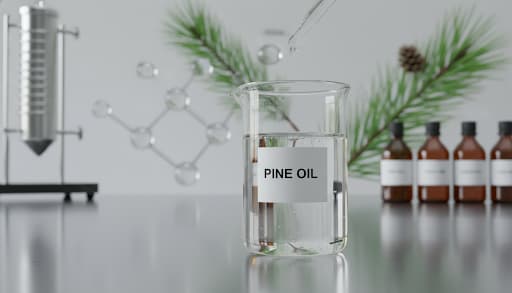
If you manufacture white phenyl, floor cleaner or disinfectants anywhere in Central India, the single most important purchasing decision you make every month is which pine oil grade to buy — and from whom.
Every week, phenyl manufacturers from Nagpur, Indore, Bhopal, Raipur and Jabalpur ask us the same questions:
- What is the actual difference between Pine Oil 22%, 32% and 42%?
- Which grade gives the best profit margin for commercial phenyl?
- How much emulsifier do I need, and should I use TRO or Alphox 200?
- Why does my phenyl separate, turn transparent or lose its smell?
This guide answers all of it — with the exact ratios used by working Indian manufacturers.
What Do the Grade Numbers Actually Mean?
Pine oil (CAS 8002-09-3) is a mixture of terpene alcohols distilled from pine resin and crude sulphate turpentine. The grade number — 22%, 32% or 42% — is the minimum terpene alcohol content. Terpene alcohols are the active part of the oil: they carry the pine fragrance, they emulsify into that classic milky-white phenyl, and they provide the natural antiseptic action.
Higher terpene alcohol content means stronger fragrance, better emulsion stability, better germ-kill claim support — and a higher price per kg.
| Grade | Terpene Alcohols | Fragrance Strength | Best Use |
|---|---|---|---|
| Pine Oil 22% | ≥ 22% | Mild | Economy white phenyl, sanitary cleaners, urinal blocks |
| Pine Oil 32% ⭐ | ≥ 32% | Strong | Standard commercial phenyl, floor cleaners — the most popular grade |
| Pine Oil 42% | ≥ 42% | Very strong, long-lasting | Premium concentrated phenyl, branded FMCG floor cleaners |
💡 Rule of thumb used by Indian phenyl manufacturers:
"Selling on price? Use 22%. Selling on quality? Use 32%. Building a brand? Use 42%."
How to Make White Phenyl From Pine Oil — Step by Step
What You Need
- Pine Oil — 22% or 32% grade
- Emulsifier — Turkey Red Oil (TRO) or Alphox 200
- Soft water — TDS below 150 ppm (hard water breaks the emulsion)
- SS or HDPE mixing vessel with stirrer
Step 1 — Make the Concentrate
- Measure 1 part pine oil into the mixing vessel.
- Add 1 to 1.5 parts emulsifier by weight.
- Stir at medium speed for 15–20 minutes until completely uniform and glossy.
Step 2 — Emulsify With Water
- Add soft water slowly, in a thin stream, while stirring continuously.
- The mixture will turn milky white — this is the phenyl concentrate.
- Never dump water in at once — fast addition breaks the emulsion permanently.
Step 3 — Dilute for Sale
- Dilute the concentrate 1:20 to 1:40 with water depending on your target strength and price point.
- Fill into HDPE bottles or cans. Label with batch number and date.
warning MOST COMMON MISTAKE
Cutting the emulsifier below 1:1 to save cost. The emulsion looks fine on day one, then separates in the bottle within a week — and the retailer never reorders. Keep emulsifier at 1 to 1.5 times the pine oil weight.
TRO vs Alphox 200 — Which Emulsifier Should You Use?
| Property | Turkey Red Oil (TRO) | Alphox 200 |
|---|---|---|
| Cost | Lower — traditional choice | Higher, but used in smaller quantity |
| Emulsion stability | Good | Excellent — longer shelf life |
| Hard water tolerance | Poor — needs soft water | Much better |
| Whiteness of phenyl | Classic milky white | Brighter white, finer emulsion |
Many working manufacturers blend both: TRO for cost, a portion of Alphox 200 for stability — especially in hard-water districts of Madhya Pradesh and Vidarbha.
Troubleshooting — Why Your Phenyl Fails
-
1. Phenyl separates into layers in the bottle:
Cause: Emulsifier ratio too low, or water added too fast. Fix: Keep emulsifier at 1–1.5× pine oil weight; add water in a slow stream with continuous stirring. -
2. Phenyl is transparent instead of milky white:
Cause: Over-dilution or too little pine oil in the concentrate. Fix: Reduce dilution ratio; verify your pine oil grade with the supplier's COA. -
3. Smell fades within days:
Cause: Low-grade or adulterated pine oil. Fix: Buy 32% instead of 22% for retail products, and only buy from suppliers who provide a COA per batch. -
4. Emulsion breaks in winter:
Cause: Pine oil clouding below 15°C. Fix: Store drums at 15–35°C; warm slowly in a water bath before use — never open flame.
Buying Pine Oil in Bulk — Practical Notes for Central India
- Packaging: 210L drums, HDPE or mild steel.
- HSN / GST: HSN 3805 (38059030), 18% GST — fully recoverable as ITC for registered manufacturers.
- Freight economics: Sourcing from Mumbai/Gujarat adds ₹2–4 per kg in freight to MP, Vidarbha and Chhattisgarh. Nagpur dispatch cuts this significantly — it is the geographic centre of India.
- Always demand a COA — terpene alcohol content is the number you're paying for. No COA, no deal.
FragVansh supplies all three pine oil grades plus the complete phenyl raw-material kit (TRO, Alphox 200, phenyl compound) from Nagpur with 1–3 day delivery across Central India. See the full Pine Oil — Central India supply hub or request today's drum price.
Frequently Asked Questions
What is the difference between Pine Oil 22%, 32% and 42%?
The number is the minimum terpene alcohol content — the active that provides fragrance, emulsification and antiseptic action. 22% is the economy grade for high-volume phenyl, 32% is the standard commercial grade, and 42% is the premium grade for concentrated phenyl and branded floor cleaners.
How much pine oil do I need to make white phenyl?
A standard concentrate uses 1 part pine oil to 1–1.5 parts emulsifier. The concentrate is then diluted 1:20 to 1:40 with water — so one 210L drum of pine oil produces several thousand litres of finished commercial phenyl.
Why does my white phenyl separate or turn transparent?
Insufficient emulsifier, water added too fast, hard water, or degraded pine oil. Keep emulsifier at 1–1.5× the pine oil weight, add water slowly with continuous stirring, and use soft water with TDS below 150 ppm.
Which emulsifier is better — TRO or Alphox 200?
TRO is cheaper and gives the classic milky phenyl; Alphox 200 gives a whiter, more stable emulsion with better hard-water tolerance. Many manufacturers blend both.
Where can I buy pine oil in bulk in Central India?
FragVansh supplies Pine Oil 22%, 32% and 42% in 210L drums from Nagpur with 1–3 day delivery across Madhya Pradesh, Vidarbha and Chhattisgarh — Indore, Bhopal, Raipur, Jabalpur, Gwalior, Bilaspur and more. Call or WhatsApp +91 74477 17744.
What is the shelf life of pine oil?
18–24 months in sealed drums stored away from sunlight at 15–35°C. Winter cloudiness is normal and reverses on slow warming to room temperature.

About FragVansh Aromatic Elements
FragVansh Aromatic Elements is a Nagpur-based B2B specialty chemicals company and Central India's bulk pine oil supplier. We stock Pine Oil 22/32/42%, TRO, Alphox 200, LABSA, SLES and 26+ specialty chemicals with pan-India dispatch.
Visit the Pine Oil Hub →Disclaimer: The formulations and ratios provided in this blog are for general guidance only. Always conduct small-scale trials before full production. Consult a qualified chemical engineer for commercial-scale manufacturing. FragVansh Aromatic Elements is not liable for any outcomes resulting from the use of information in this article.